Understanding Shin Splints
If you run regularly, chances are you’ve either heard of shin splints—or felt that sharp, nagging pain in your lower leg mid-run.
They’re one of the most common running-related injuries, affecting around 12–17% of runners.
So what actually are shin splints—and more importantly, how do you get them under control?
What Are Shin Splints?
“Shin splints” isn’t a single diagnosis. It’s an umbrella term used to describe pain along the shin, typically caused by overload of the tissues in the lower leg.
Broadly, this pain falls into three categories:
- Muscular overload
- Medial Tibial Stress Syndrome (MTSS)
- Stress fractures
Understanding which one you’re dealing with is key to managing it properly.
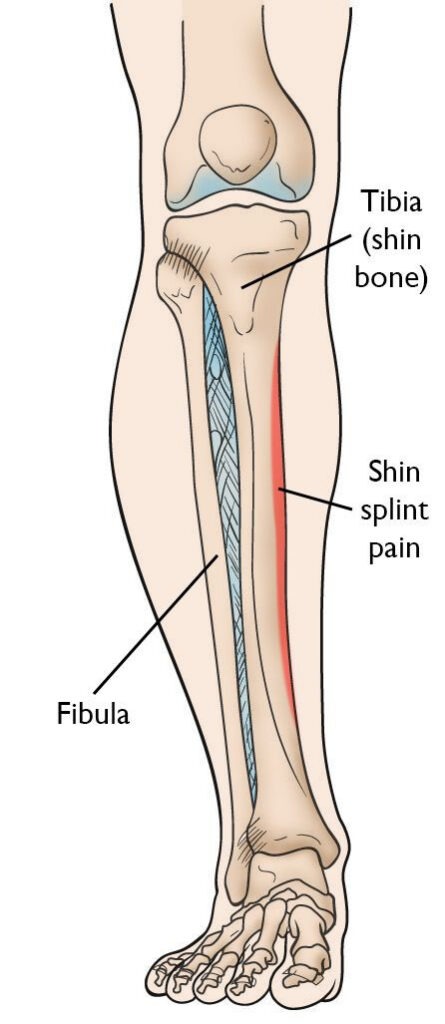
1. Muscular Shin Pain
The most common cause is muscular—usually involving the tibialis posterior or tibialis anterior.
These muscles help control your foot and ankle during running. When load increases too quickly, they can become irritated.
Common Triggers
- Doing too much, too soon
- Sudden changes in training volume or intensity
- Biomechanical factors (e.g. overpronation)
Where You Feel It
- Inside of the shin → tibialis posterior
- Outer/front of the shin → tibialis anterior
Pain is often:
- Sharp and repetitive
- Worse at the start of a run
- Eases as you warm up
- Returns afterwards
Managing Muscular Shin Pain
Management is simple—but needs to be consistent:
1. Load management
Temporarily reduce running volume or intensity, then gradually rebuild.
2. Strength work
Focus on calf strength and ankle control:
- Calf raises
- Tibialis raises
- Resistance band work
3. Short-term support (if needed)
Taping can offload the area temporarily—but it doesn’t fix the root cause.
2. Medial Tibial Stress Syndrome (MTSS)
MTSS is what most people are referring to when they say “shin splints.”
It involves irritation of the periosteum—the outer layer of the bone—caused by repeated stress.
Common Triggers
- Rapid increases in training load
- Changes in footwear or surface
- Prolonged overpronation
Symptoms
- Pain along the inner lower third of the shin
- Tenderness over a wider area
- Possible mild swelling
Managing MTSS
This requires a slightly more cautious approach:
- Reduce or temporarily stop running
- Use ice to help manage symptoms
- Gradually return to running (starting on softer surfaces can help)
That said—don’t avoid harder surfaces long-term if that’s your goal. The key is progressive exposure.
If symptoms persist, imaging may be needed to rule out something more serious.
3. Stress Fractures
At the more severe end of the spectrum, shin pain may indicate a stress fracture.
This is a small crack in the bone caused by repeated loading without adequate recovery.
Higher Risk Groups
- Low bone density
- Metabolic conditions (e.g. osteoporosis, diabetes)
- High training loads without recovery
Key Signs
- Pain that worsens with activity
- Pain that settles with rest
- Very localised (one specific spot)
Management
This is not one to push through.
Accurate diagnosis is essential—this may involve clinical assessment and imaging.
Management typically requires:
- Rest from impact activity
- Gradual, structured return to loading
When Should You Get It Checked?
If your pain:
- Isn’t improving with simple load reduction
- Is getting worse over time
- Feels very localised or sharp
…it’s worth getting assessed properly.
Final Thoughts
Shin splints are common—but they’re also very manageable when you understand what’s driving them.
In most cases, it comes down to one thing:
👉 Load exceeding capacity
Build that capacity properly, and you don’t just recover—you come back stronger.
Ignore early warning signs, though, and what starts as a minor irritation can progress into something far more limiting. The goal isn’t just to get out of pain—it’s to build resilience so your body can tolerate the demands you place on it long-term.